
Every gathering, whether a festival, retreat, wedding, party, or conference, needs spaces where people can ease their nervous systems, reconnect with themselves, and build belonging in a way that feels gentle and real. The information below is what we’ve learned by having a Rest and Rejuvenation Station at Cascadia Song Rise, an annual gathering of about 333 people who sing and camp in nature.
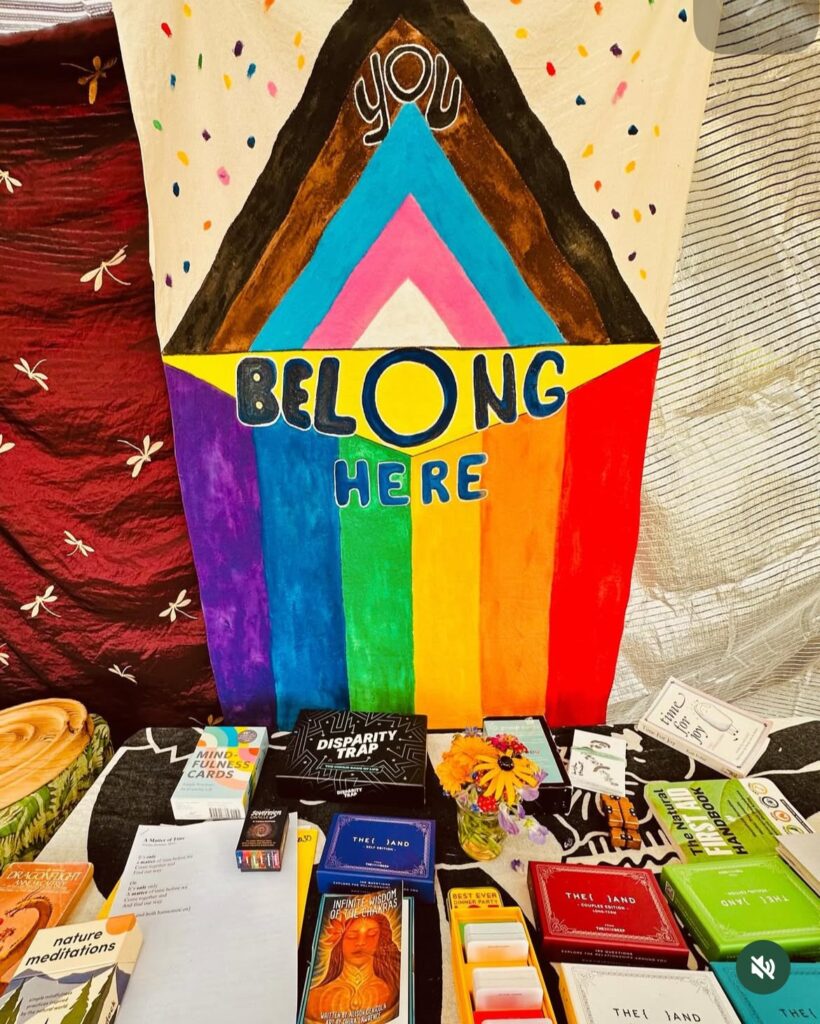
The Rest and Rejuvenation Station is a low-demand, welcoming place for quiet, reflection, or honest connection.
It’s a space that invites people to breathe, be, and care for one another, without pressure to perform, fix, or produce.
This space is especially helpful for any person who needs a felt sense of belonging at the gathering. From neurodivergent folks to elders to trans folks to BIPOC folks to disabled folks to people who moved when they were in kindergarten, this space is a chance to experience something that contradicts the story of “I don’t fit in.”
It’s a place at the gathering that reassures us: You Belong Here.
Why Create a Rest and Rejuvenation Station?
The station offers:
- A pause from overstimulation (crowds, bright lights, noise, and busy-ness)
- A place for quiet, rest, and self-tending
- A space for authentic connection, where people can have real talk about care, kinship, and belonging with others who value these things
- A felt sense of inclusion and bravery, where no one needs to explain their need for rest and belonging that we all carry
How to Set Up the Space – Overview
- Rugs, soft ground covers, hammocks, cushions, low chairs (consider disability, size, etc. when choosing)
- Offer seating at different heights (cushions, chairs, mats) and space for mobility devices
- Set clear borders for the space with rugs, screens, or low furniture
- Natural objects (stones, branches, flowers) that invite touch and connection
- Two spaces are ideal – one nearby for conflict resolution or 1-1 time with a Kinship Tender to hold space.
If you’re outdoors:
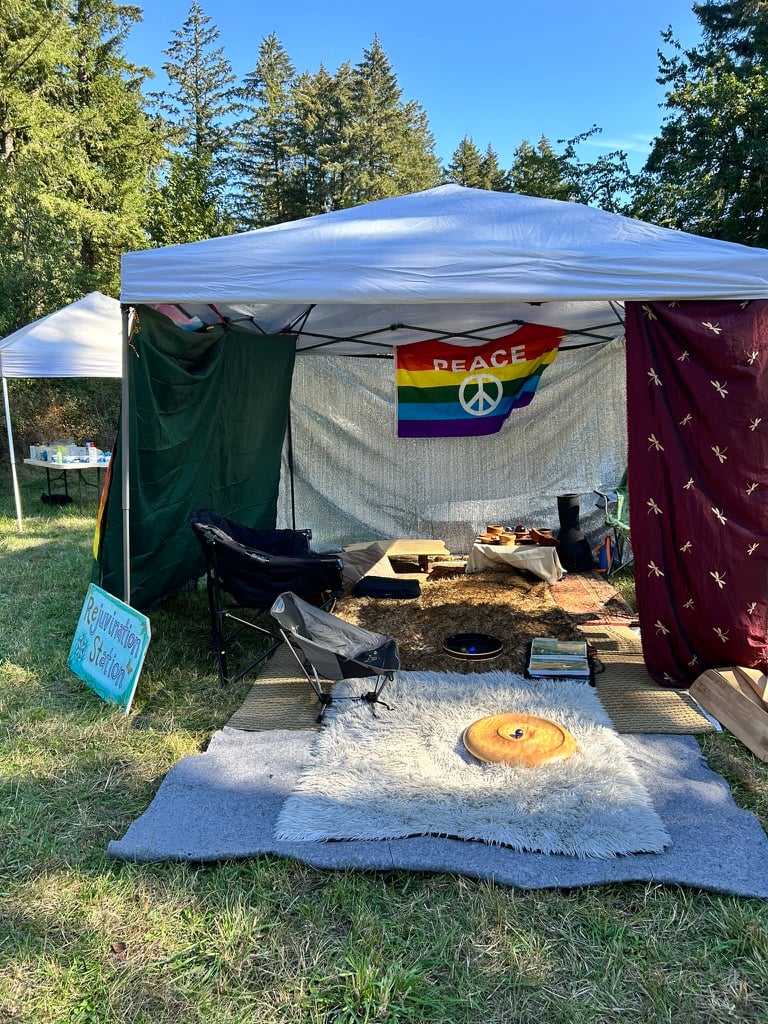
- A tent or shelter that offers shade and wind protection.
- There are silver knitted shade cloths that allow wind through.
- Anchor your tent well with rocks or other items and make sure folks can see the ropes & not trip.
- Light them if the space is used at night or walked past.
- Find a spot with natural shelter in addition to your tent. Trees, shrubs, or land contours that offer windbreak, dappled light, or sound buffering without isolating the space too much.
- Consider soundscape. Aim for distance from generators, main stages, loud group areas, or traffic. Choose a spot where natural sounds (birds, breeze) can help soothe.
- Balance accessibility + seclusion. Pick a place easy to find and reach (clear paths, near main flows) but not so central that it feels exposed or busy.
- Watch the wind. Avoid open, breezy ridges or funnels where wind could whip through. A slightly lower spot often feels more grounded and sheltered.
- Sun and shade patterns. Observe how sun moves across the site. A spot that offers shade during peak heat hours makes a huge difference.
- Avoid damp or flood-prone areas — choose ground that drains well if rain comes, and steer clear of spots where water pools. Avoid being near ponds, which may come with mosquitos.
- Think about terrain. Choose level ground that works for mobility aids, folks with limited stamina, or those who want to sit/lie down comfortably.
- Proximity to bathrooms and water. Aim for close enough for easy access, but not so near that there’s a lot of foot traffic or smells.
- If there are affinity spaces (BIPOC space, for example), give the coordinators of that space first choice of location.
- Water station, sun hats, hand fans.
- A cooler with cold washcloths or sprays on hot days.
- A warm blanket station for cooler weather.
If you’re indoors:
- Do you have electricity? Do you need it for lamps or heating pads?
- Attune to the sounds of the space
- Offer earplugs or noise-reducing headphones for those who need them.
- Place soft objects (cushions, bean bags) strategically to help absorb noise.
- Use a white noise machine or a small fountain (if appropriate) to create a gentle sound buffer. There are actually some of these that are battery powered, too, for outdoor use.
- If air stuffiness or AC is a problem
- Bring shawls or light blankets for warmth.
- Provide small hand fans or battery-powered fans for air movement in stuffy spaces.
- Place the station near windows (with permission) for fresh air flow if possible.
- Use lamp lighting, fabric drapes, or light filters to soften harsh overhead lights
- Use lamps with warm bulbs if allowed.
- Hang lightweight fabric over bright lights (check venue rules) or use clip-on shades.
- Choose a corner or a room with the most natural light, if possible.
Examples of what to include or consider (indoors or out):
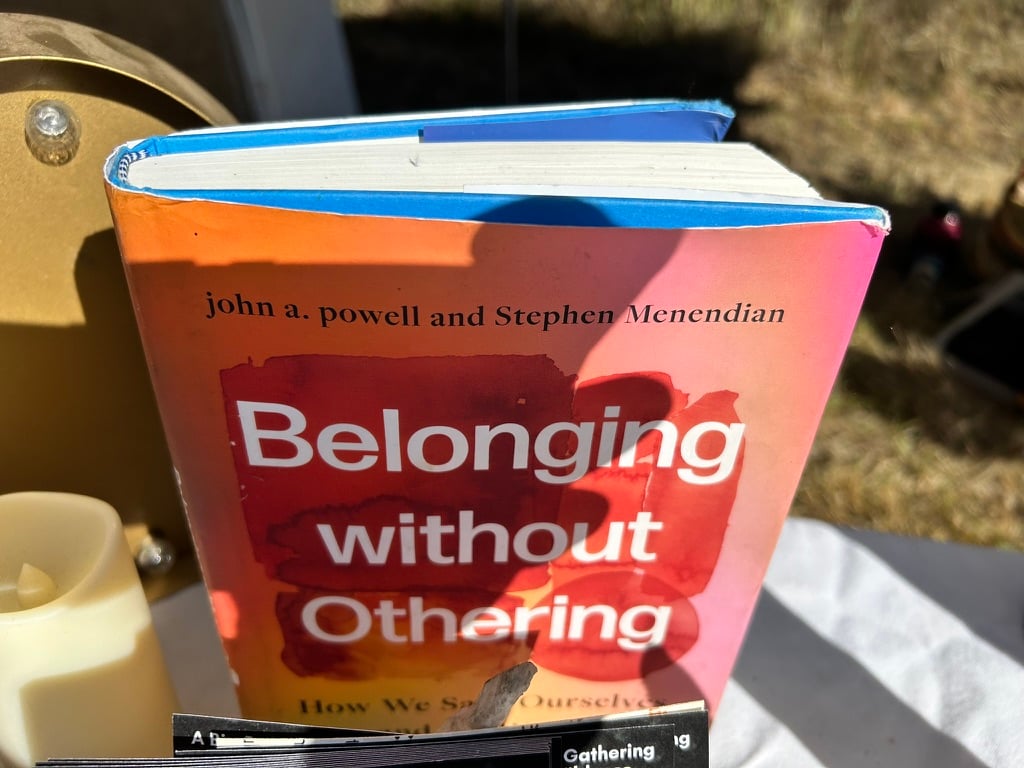
- Sensory-friendly objects:
- Fidgets, soft fabrics, weighted items
- Balance boards or squishy things to stand on to regain balance in all the ways (canes for support could be helpful)
- Books, wisdom cards, cards with conversation prompts for real talk
- Gentle art supplies (colored pencils, simple sketch pads)
- Subtle, natural, intentional decorations. Nothing should be overwhelming or appropriative
- Clear, wide paths and uncluttered spaces for ease of movement (Avoid creating tight corners or dead-ends in layout)
- Earplugs or noise-canceling options if ambient noise is a factor
- A low table or tray for folks who want to rest tea, water, or objects beside them
- Throw blankets, weighted blanket
- A small basket of unscented lotion or balm
- Pride flags or signs that signal welcome
- A simple sign: You Belong Here. Rest. Belonging. Care.
- Clear posted agreements (e.g. “Please keep this a low-demand, low-stimulation space”)
- Information about kinship tending skills
- Imagine all of the various folks who might use this space and consider their experience upon arrival. Plan for what could be restful and welcoming for folks who are different from you or similar. Consider age, race, size, disability, gender, gender expression, neurodivergence, class, parenthood, menstruation, menopause, belief systems, etc. (Note, we usually also plan for a separate kids area as well, so when we consider age here, we are primarily thinking elders – but also consider solo partents and there may be lightly-supervised children as well).
Kinship Tending in Setup and Breakdown
The care starts before the first guest enters. The setup is a time for the Kinship Tending team to connect intentionally:
- Pause together before setting up: share a breath, an intention, a grounding moment. Calling in supports, like ancestors or other spiritual guides.
- Set the space with welcome in your hearts. Each object is placed with care.
- Take a moment before breaking down the space to express gratitude to the land, the supports, the space, each other.
- Break down the space with intention, honoring the space and the care it held.
These moments help the space carry that energy of belonging, not just a look of comfort, but a felt sense of it.
Final Thought: These Spaces are Essential for Kinship Tending
A Rest and Rejuvenation Station isn’t just a nice extra, it’s part of how we create gatherings where people feel seen, nourished, and whole. It says: You matter. Care matters. Rest and kinship belong at the center of how we gather.
If your gathering is small, it might just be a quiet corner of the room. If it’s large, you might want multiple stations that meet this need. You’ll also want spaces for affinity groups to meet, especially folks who experience significant systemic marginalization. BIPOC spaces, LQBTQIA+ spaces, genderqueer spaces, Elder spaces, etc. The specificity of these depend on your gathering and how many folks there are present with those lived experiences that might need to cocoon for resilience.
Plan the Rest & Rejuvenation Station with heart, tend it with care, and your community will feel that welcome long after the event is over.
Not only that, they’ll be bringing these skills home with them, to the wider world.